Detection Strategies for Mycobacterium tuberculosis
Mycobacterium tuberculosis (mTb) affects approximately one third of the world population and is a serious health problem. Unless new assays are developed to quickly and accurately diagnose the disease, mTb will continue to spread. These new assays must be easy to use, affordable, portable, sensitive, and specific in order for implementation at the point of care (POC) which is typically in third world countries. The purpose of my work was to access the practicality of using a quartz crystal microbalance (QCM) to detect mTb. A QCM biosensor has been successfully employed to screen for the presence of mTb through the detection of whole cells and one of its surface antigen, lipoarabinomannan (LAM). LAM in particular is of great interest for POC detection with an extracellular position and high prevalence in exhaled breath which allows for a minimally invasive detection method. LAM detection could help differentiate between infected individuals with active or latent disease. Using these biosensors to detect mTb and LAM contributes to the worldwide goal of diagnosing mTb worldwide.
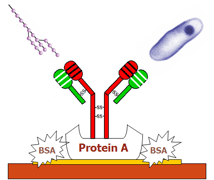
Shown above is an example of a biosensor as it would be assembled within a QCM. Protein A binds to the gold surface, then BSA blocks remaining sites on the gold surface. The Fc region of the antibody interacts with a binding site on protein A and adsorbs to the surface. Finally, the detection of tuberculosis is achieved through the interaction with the antibody.
Secondarily, I am working to develop an electrochemical assay for the detection of oxidative bursts from activated macrophages. Over the lifetime of a cell, exposure to or production of many oxidizing species remains low but is increased at times of oxidative stress. Extended exposure to reactive oxygen species (ROS) can lead to intracellular modification of proteins, lipids and DNA. ROS can be beneficial to the host through the use of an oxidative burst as the defense mechanism whereby macrophages, white blood cells, release ROS to degrade and eliminate foreign particles and bacteria. Some bacteria and parasites, such as tuberculosis and malaria, have developed means through which they evade this mechanism of macrophage defenses, allowing continued proliferation. Hydrogen peroxide and reactive nitrogen species are stable products commonly measured to indicate oxidative stress. Since these molecules are also products of other cellular reactions, the detection of superoxide (SO) itself was used to differentiate among cellular pathways. A new superoxide dismutase (SOD)-coated electrode has the sensitivity and specificity to allow for measurement of SO radicals. Examining the metabolic profile of macrophages in a microfluidic environment, with the introduction of this new SOD electrode, during oxidative burst provides a method for studying evasion of macrophage defenses by tuberculosis.
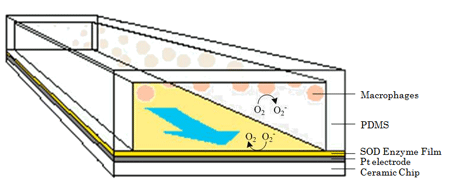
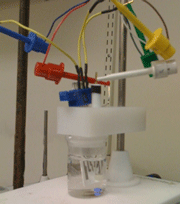
Shown above is a diagram depicting how the SOD electrode assays for macrophage SO production within a microfluidic environment. The picture below shows how the enzyme coated electrode was calibrated in a bulk solution.